
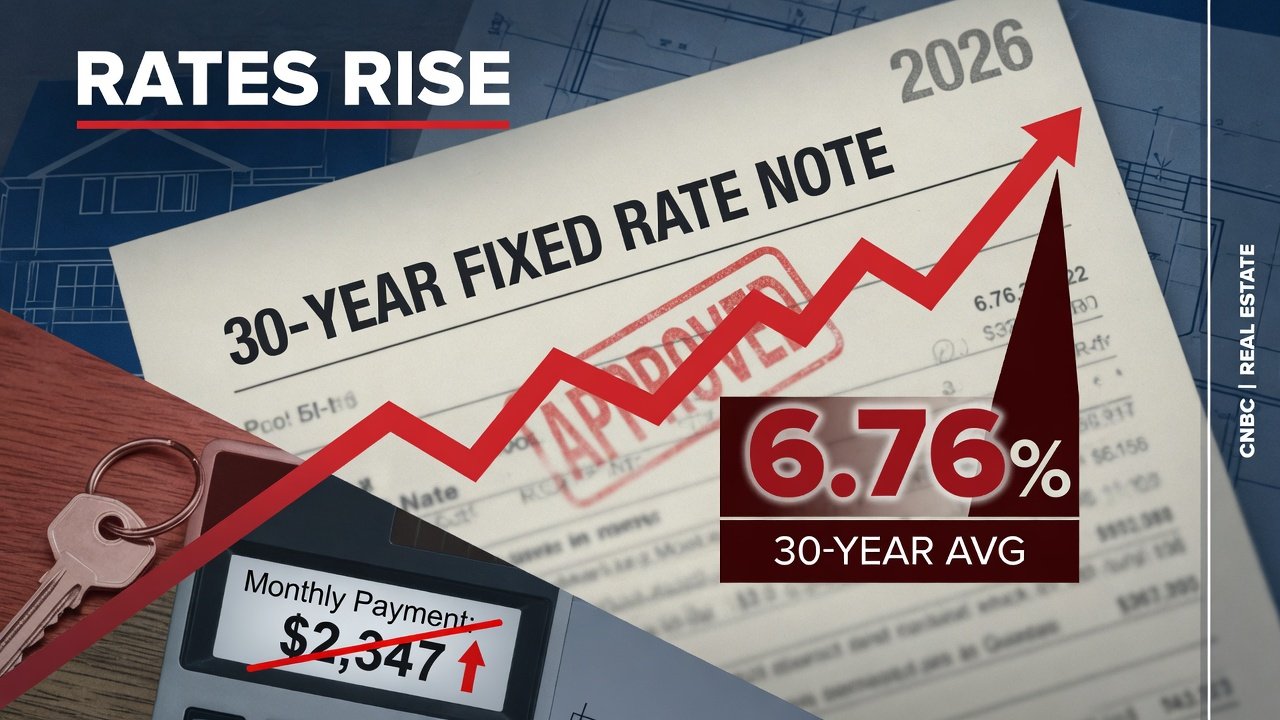
US Mortgage Rates Rise in 2026 as 30-Year Home Loan Rate Reaches 6.76%
US Mortgage Rates are moving in the opposite direction from the multi-year lows suggested by some recent headlines, with the average 30-year fixed mortgage rate climbing to 6.76% as of September 10, 2026, according to Freddie Mac.
The rate increased from 6.71% a week earlier and 6.66% on August 27. A year ago, the comparable 30-year mortgage rate stood at 6.35%.
The increase comes at a difficult time for the US housing market, where high home prices and elevated borrowing costs have already limited activity. Rising Treasury yields, inflation concerns and uncertainty surrounding Federal Reserve policy are adding further pressure to mortgage rates.
30-Year Mortgage Rates Reach 6.76%
Freddie Mac’s Primary Mortgage Market Survey showed the average 30-year fixed-rate mortgage at 6.76% for the week ending September 10.
The 15-year fixed mortgage rate also increased, reaching 6.09%, compared with 6.04% a week earlier.
Mortgage rates have moved higher after briefly declining earlier in the year.
The 30-year rate was below 6% during parts of early 2026, but rising inflation expectations, higher bond yields and broader economic uncertainty have pushed borrowing costs higher again.
Why Are US Mortgage Rates Rising?
Mortgage rates do not move directly with the Federal Reserve’s benchmark interest rate.
Instead, they are strongly influenced by longer-term Treasury yields, particularly the 10-year Treasury yield.
Recently, Treasury yields have risen as investors have reassessed inflation, government borrowing and future Federal Reserve policy.
The 10-year Treasury yield has moved close to or above 5%, increasing the pressure on mortgage rates. Reuters reported that the average 30-year mortgage rate had climbed to around 6.85% in early September, while Freddie Mac’s weekly survey later showed 6.76%.
Inflation Is Creating More Pressure
Inflation remains one of the biggest concerns for financial markets.
Higher energy prices, particularly crude oil, have contributed to renewed inflation worries. The increase in oil prices has also complicated the Federal Reserve’s policy decisions ahead of its September meeting.
The Fed’s decisions matter for the broader economy because higher interest rates can increase borrowing costs. However, mortgage rates can continue rising even when markets expect changes in the Fed’s short-term policy rate because investors also react to long-term inflation and government borrowing expectations.
Housing Affordability Remains a Challenge
Higher mortgage rates are particularly important for prospective homebuyers because they directly affect monthly payments.
Freddie Mac estimates that a $300,000 30-year mortgage at 6.5% would require roughly $1,896 per month in principal and interest. At 7%, the payment rises to approximately $1,996.
That difference can significantly affect how much a household can afford to borrow.
For buyers already dealing with high home prices, even a relatively small increase in mortgage rates can reduce purchasing power.
Home Sales Are Already Under Pressure
The housing market has been struggling to regain momentum.
Existing US home sales fell 2% in August to an annualized rate of 3.98 million units, the lowest level since June 2025, according to the National Association of Realtors data reported by Reuters.
The decline came as mortgage rates increased and affordability remained difficult.
At the same time, housing inventory has improved. The increase in available homes could eventually provide buyers with more choices, but higher borrowing costs are preventing many potential buyers from returning to the market.
More Homes Are Available, But Buyers Remain Cautious
One unusual feature of the current US housing market is the combination of higher inventory and weak transaction activity.
Existing-home inventory reached around 1.62 million units in August, according to Reuters, representing the highest level since late 2019. That translated into approximately 4.9 months of supply.
Ordinarily, increased inventory could provide relief for buyers.
However, affordability remains a major obstacle because mortgage rates are still well above the levels many homeowners locked in before the recent period of high interest rates.
Why Existing Homeowners Are Not Selling
Many current homeowners have mortgages with rates significantly below today’s market rates.
That creates what economists often describe as a mortgage lock-in effect.
A homeowner with a mortgage at a much lower rate may hesitate to sell because buying another home would require taking on a new loan at a substantially higher interest rate.
As a result, homeowners may stay in their existing properties longer than they otherwise would.
This limits the supply of homes available for sale and contributes to the unusual combination of high inventory relative to recent years but still-low transaction volumes.
Refinancing Demand Remains Rate Sensitive
Refinancing activity is also highly sensitive to mortgage rates.
When rates fall significantly below the rate on an existing mortgage, homeowners may refinance to reduce monthly payments or alter the terms of their loans.
However, rising mortgage rates reduce the number of homeowners who can benefit from refinancing.
Reuters reported that refinancing activity fell 6.2% in the week covered by its September 9 report, while total mortgage applications declined 2.7%.
That is the opposite of the sudden refinancing boom that would normally accompany a major decline in mortgage rates.
What the Federal Reserve Means for Mortgage Rates
The Federal Reserve remains a major focus for housing-market participants.
The central bank was scheduled to meet on September 15 and 16, with markets closely watching its decision and policy outlook.
Current expectations have shifted significantly because of persistent inflation and higher oil prices. Economists surveyed by Reuters were increasingly expecting a rate hike rather than a cut at the September meeting.
That environment makes a rapid decline in mortgage rates less likely in the immediate future.
However, mortgage rates can move independently of the Fed’s short-term decision depending on how financial markets interpret inflation, Treasury yields and future economic conditions.
What Could Bring Mortgage Rates Down?
Mortgage rates could decline if inflation pressures ease, Treasury yields fall and investors become more confident that monetary policy can become less restrictive.
A sustained decline in energy prices could also reduce inflation concerns.
A weaker economy could potentially encourage lower long-term bond yields, which could eventually put downward pressure on mortgage rates.
But current forecasts suggest that a rapid return to the unusually low mortgage rates seen before 2022 remains unlikely.
Reuters reported that economists expect the average US mortgage rate to remain around 6.60% over the next two quarters, reflecting continued affordability challenges.
What This Means for Homebuyers
For prospective buyers, today’s environment requires careful financial planning.
A lower mortgage rate can improve affordability, but waiting for a dramatic decline also carries risks because home prices, inventory and borrowing costs can all change.
Buyers should compare multiple mortgage offers rather than relying solely on the national average. Freddie Mac also advises borrowers to shop around because differences between lender offers can translate into substantial savings over the life of a mortgage.
What This Means for the US Housing Market
The housing market is likely to remain highly sensitive to mortgage rates throughout the rest of 2026.
If rates remain above 6%, affordability will continue to be a major issue for first-time buyers.
However, increasing inventory could gradually give buyers more negotiating power, particularly in markets where sellers are under pressure.
The combination of higher supply and expensive financing means the housing recovery is likely to remain uneven.
The Outlook for US Mortgage Rates
The latest data show that the US mortgage market is facing renewed upward pressure rather than a multi-year low.
Freddie Mac’s 6.76% average for the 30-year fixed mortgage is significantly above the lows reached earlier in 2026.
For borrowers, the key factors to watch will be inflation, Treasury yields, oil prices and Federal Reserve policy.
A sustained improvement in those areas could eventually bring mortgage rates lower. For now, however, buyers and homeowners should prepare for a market in which borrowing costs remain elevated.
Frequently Asked Questions
What is the current average US mortgage rate?
Freddie Mac reported that the average 30-year fixed mortgage rate was 6.76% as of September 10, 2026, up from 6.71% the previous week.
Are US mortgage rates at a three-year low?
No. Current data show the opposite. Mortgage rates have risen during September 2026, with the 30-year fixed rate at 6.76% according to Freddie Mac.
Why are US mortgage rates rising?
Higher Treasury yields, persistent inflation concerns, elevated oil prices and uncertainty over Federal Reserve policy are among the factors putting upward pressure on mortgage rates.
Are refinancing applications increasing?
Recent data do not show a broad refinancing surge. Reuters reported that refinancing activity declined 6.2% in the week covered by its September 9 report as mortgage rates moved higher.
How do mortgage rates affect homebuyers?
Higher mortgage rates increase monthly payments and reduce the amount buyers can borrow while staying within the same budget. Lower rates generally increase purchasing power.
Could mortgage rates fall later in 2026?
They could if inflation and Treasury yields decline, but current forecasts suggest rates are likely to remain elevated. Reuters reported expectations for average mortgage rates around 6.60% over the next two quarters.
What should homebuyers do when mortgage rates are high?
Buyers should compare multiple lenders, consider their complete monthly housing costs and avoid stretching their budgets. Freddie Mac specifically recommends shopping around for mortgage quotes.
