
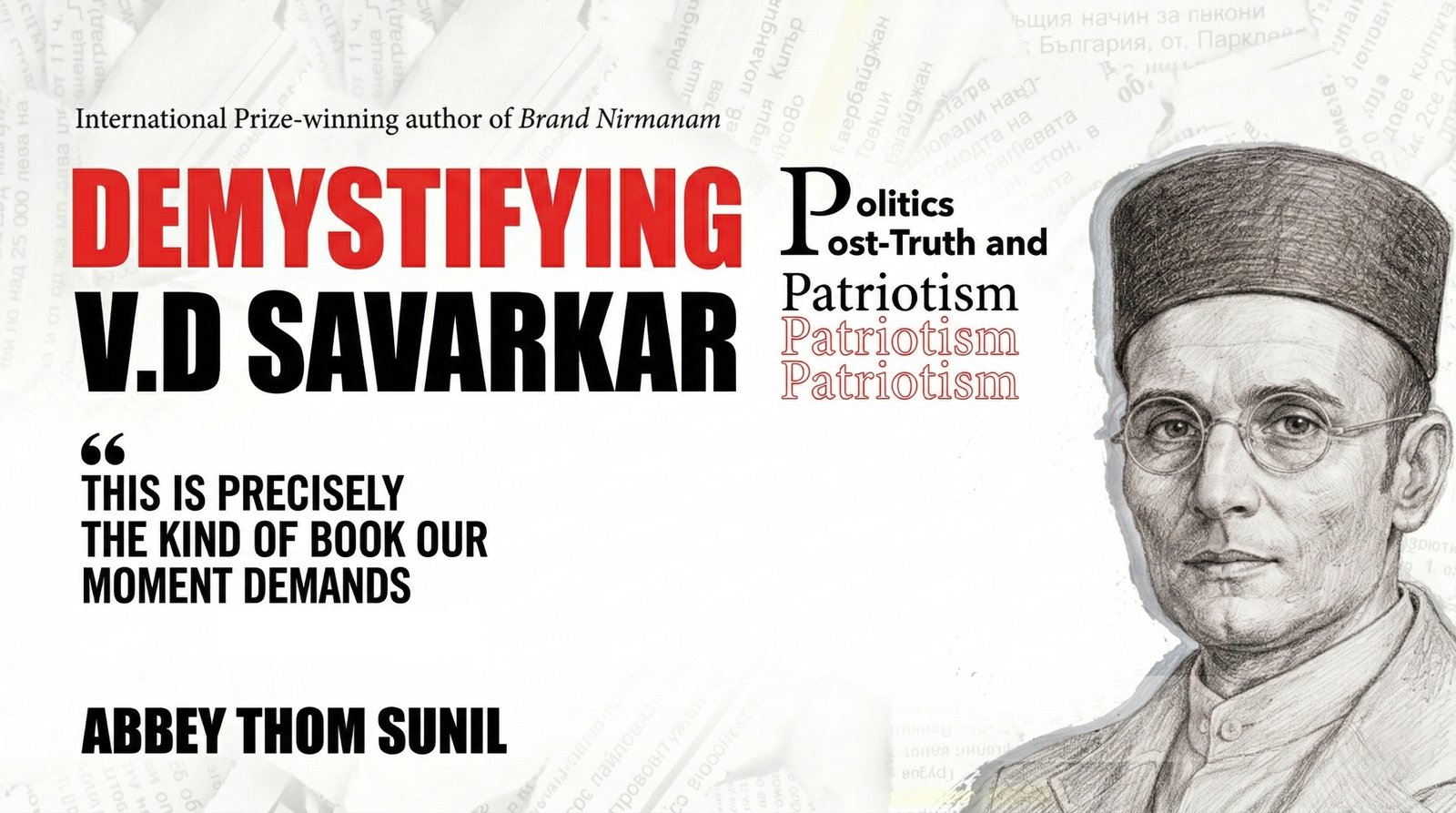
In an era where historical narratives are increasingly weaponized for political gain, Abbey Thom Sunil’s forthcoming book, “Demystifying V D Savarkar: Politics, Post Truth and Patriotism,” arrives as a much- needed intervention in one of India’s most contentious biographical debates. This meticulously researched work promises to challenge readers across the ideological spectrum to confront uncomfortable truths about one of the 20th century’s most polarizing Indian political figures.
Vinayak Damodar Savarkar remains an enigma wrapped in controversy, simultaneously celebrated as a revolutionary freedom fighter and condemned as a divisive ideologue. For decades, his legacy has been filtered through partisan lenses, with hagiographies on one side and dismissive critiques on the other. What makes Sunil’s approach particularly compelling is the author’s stated commitment to examining Savarkar neither as hero nor villain, but as a complex historical figure whose ideas continue to shape contemporary Indian politics in profound and often unacknowledged ways.
The book’s subtitle “Politics, Post Truth and Patriotism” signals Sunil’s ambitious scope. By linking Savarkar’s legacy to our current post-truth political environment, the author invites readers to consider how historical narratives are constructed, contested, and deployed in service of present-day agendas. This meta-analytical framework elevates the work beyond conventional biography into the realm of critical historiography, examining not just what Savarkar said and did, but how his image has been manufactured, contested, and reimagined across generations.
Sunil’s exploration of Savarkar’s political philosophy promises to be particularly illuminating. The concept of Hindutva, which Savarkar articulated in his 1923 pamphlet, has evolved from a relatively marginal ideological position to the dominant political discourse in contemporary India. By tracing this evolution and examining Savarkar’s original formulations alongside their modern interpretations, Sunil
offers readers the tools to distinguish between historical record and political mythology which remains as an essential skill in our current moment.
The book’s treatment of patriotism appears especially timely. In an age where love of country is often conflated with allegiance to particular political parties or ideologies, Sunil’s critical examination of Savarkar’s own conception of patriotism, and the various ways it has been interpreted which includes promises to provoke necessary conversations about what it means to be patriotic in a diverse democracy. Savarkar’s complicated relationship with the British colonial government, including his famous mercy petitions, has long been a flashpoint in debates about his legacy. Sunil’s willingness to engage with these uncomfortable aspects of Savarkar’s life, rather than explaining them away, suggests a scholarly integrity that transcends partisan advocacy.
What distinguishes this work from previous treatments is Sunil’s apparent commitment to contextual understanding without moral relativism. Understanding why Savarkar wrote what he did, believed what he believed, and acted as he acted does not require endorsing his positions. This nuanced approach, increasingly rare in our polarized discourse allows for genuine historical understanding while maintaining space for ethical evaluation.
The book’s engagement with post-truth politics is particularly relevant. In recent years, Savarkar has been reimagined as everything from a proto-feminist to a staunch advocate of social reform, claims that require careful scrutiny against historical evidence. Sunil’s work promises to separate verifiable historical fact from convenient political fiction, providing readers with the evidentiary foundation necessary to form their own informed judgments.
For scholars, students, and general readers seeking to understand the ideological currents shaping contemporary India, “Demystifying V D Savarkar” appears poised to become an essential text. Sunil’s work arrives at a moment when India’s constitutional democracy faces profound challenges, many of which trace their ideological lineage to debates Savarkar himself participated in nearly a century ago. By illuminating these connections without succumbing to presentism or anachronism, the book promises to help readers understand not just Indian history, but India’s present and possible futures.
The true measure of any historical work lies not in confirming readers’ existing beliefs, but in challenging them to think more deeply and critically. If Abbey Thom Sunil delivers on the promise implicit in this provocative title, “Demystifying V D Savarkar” will spark conversations that extend far beyond academic circles, contributing meaningfully to India’s ongoing negotiation with its complex past. In a landscape crowded with partisan histories, a work committed to honest inquiry and rigorous analysis stands to make an invaluable contribution to public discourse.
This is precisely the kind of book our moment demands—one that refuses easy answers while insisting on difficult questions.
